Last updated October 15, 2026
How to Hire a ADU Contractor in Thousand Oaks: A Step-by-Step Guide
A contractor can be fully licensed, carry insurance, and still deliver a project that costs 40% more than the original quote. That is not a rare exception in Thousand Oaks; it is the predictable result of a hiring process that trusts the sales pitch instead of verifying the paperwork. This guide walks you through the exact vetting steps we use to separate disciplined builders from the ones who quote fast and deliver late, and it gives you a repeatable checklist you can run before you sign anything. By the time you finish, you will know how to check a license in minutes, how to read a bid for what is missing, and which questions to ask past clients that actually reveal whether a contractor hits deadlines in Thousand Oaks.
Quick Answer
Hiring an ADU contractor in Thousand Oaks comes down to five verification steps: check the California license classification against the CSLB, confirm who pulls the permit and whose name goes on it, demand a written fixed-price bid with line items, call two past clients and ask about schedule slips and change orders, and verify the contractor has built the specific method you want, whether that is prefab, modular, or stick-built. A contractor who passes all five is worth a serious estimate. One who resists any of them is telling you something before you sign.
Table of Contents
- Verify the License on CSLB, and Know What the Classification Means
- Permit Ownership: Who Pulls It, Whose Name Goes on It, and Why It Matters
- How to Read a Bid for What Is Missing
- Reference Checks That Actually Work: Two Questions That Reveal Real Behavior
- Red Flags Specific to the Thousand Oaks ADU Market
- Matching the Build Method to Your Budget and Lot
- The Full Hiring Checklist for an ADU Contractor in Thousand Oaks
Verify the License on CSLB, and Know What the Classification Means
The Contractors State License Board runs a searchable database at cslb.ca.gov that takes less than three minutes to use. You type in the contractor’s name or license number, and the site shows you whether the license is active, when it expires, whether there are active suspensions or revocations, and whether the contractor carries workers’ compensation insurance. If the license shows anything other than active and in good standing, you stop there. Do not call for a second chance. Do not accept an explanation.
But the classification code is where most Thousand Oaks homeowners miss something important. A California contractor license comes with a letter designation. For ADU work, the two that typically matter are “B – General Building Contractor” and “A – General Engineering Contractor,” though most ADU projects fall under B. A B license means the contractor can frame, roof, finish, and coordinate the trades for a residential structure. A C-license alone, like a C-36 plumbing or C-15 flooring, means the holder is licensed for that single trade, not for running the whole job. If a contractor hands you a C-license and says they will manage your entire ADU from foundation to finish, they are bidding beyond their classification, and your permit application will expose it.
Thousand Oaks sits in Ventura County, where the building and safety code enforcement is consistent and the inspectors expect the paperwork to match the license. The city does not issue ADU permits to a license classification that does not cover the scope. That means a mistake on the license check does not just delay the job; it can void the permit before a trench is dug. Verification is not optional. It is the floor.
We tell every homeowner the same thing in our first consult: a state-issued B license is the minimum to be on this property. The Garrison Code, the operating standard we build under, starts with showing up clean on paper. You can check that in one sitting at a kitchen table.
Permit Ownership: Who Pulls It, Whose Name Goes on It, and Why It Matters
The permit is not a formality. It is the document that tells the city who is responsible for the work. And in Thousand Oaks, where ADU permits run through the city’s Building & Safety Division, the name on the permit determines who the inspector holds accountable and who carries the liability if something fails.
Ask your contractor one direct question before signing: “Who pulls the permit, and whose name goes on it?” The answer you want is that the contractor pulls it, in the contractor’s name and license number. That means the contractor is the permit holder of record, and the city inspection goes against their license. The alternative, a permit pulled in the homeowner’s name, is legal in some cases but transfers construction liability onto you. If the work does not pass inspection, the city’s correction notice has your name on it. And if the contractor walks away mid-job, you are the one left with an open permit and no licensed builder attached to it.
There is a second reason this matters in Thousand Oaks specifically: ADU construction in this city often requires a site plan review, a zoning check for setbacks and lot coverage, and sometimes a coastal or hillside addendum depending on where you are. A contractor who pulls the permit owns the responsibility to make sure the plans are approvable before a shovel goes in. A contractor who asks you to pull it is shifting risk in a way that costs you time and money later.
Permit ownership also tells you how the contractor handles pressure. A builder who pulls permits in their name is confident enough in their work to let an inspector hold them to code. That is the builder you want on an ADU.
How to Read a Bid for What Is Missing
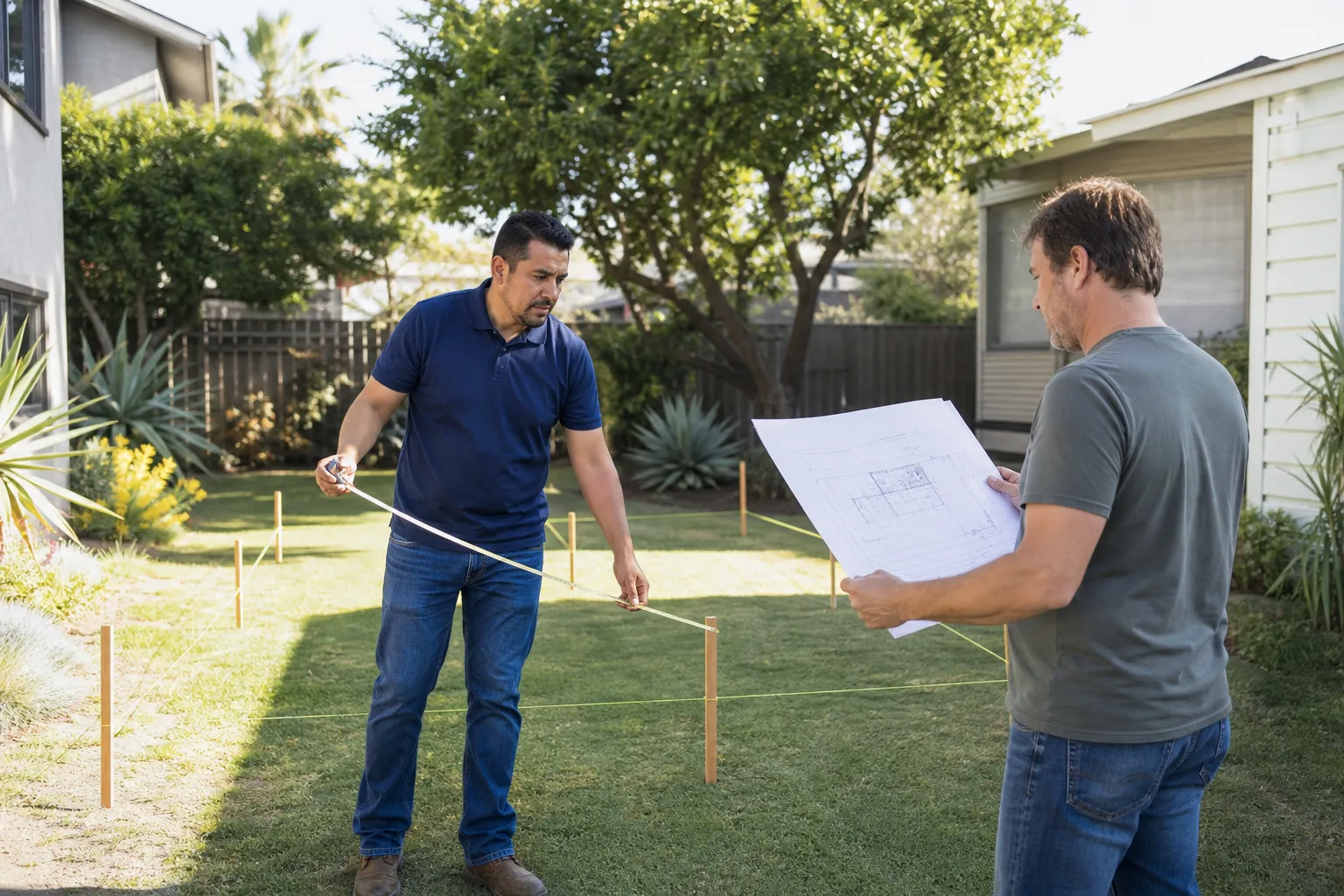
A real fixed-price bid is not a number on a line. It is a list of scope, materials, allowances, and exclusions written plainly enough that you can compare it against another bid line by line. Most homeowners in Thousand Oaks do not get that. They get a three-page proposal that names the broad strokes, a price, and a sentence about standard allowances. Then the project starts, and the allowance runs out, or the trenching hits rock, or the electrical panel turns out to be undersized, and the change orders begin.
Here is how to read a bid for what is missing:
- Look for a site-specific line item. If the bid does not mention your parcel’s access, slope, or existing utilities, the contractor has not walked the property with a real eye. In the hills above Thousand Oaks, fill soil and retaining conditions change costs. If it is not in the bid, it will be in a change order.
- Check the allowance section. Flooring, fixtures, appliances, countertops. If the allowance is low, ask for a realistic number. Builders who show you a low allowance to win the job will make up the difference when you choose the finish you actually want.
- Find the exclusions paragraph. This is where the rise hides. Utility trenching, demolition, dump fees, switch panel upgrades, permit fees, site access improvements. If the paragraph is short, ask the contractor to name everything not included. In writing.
- Look for the price-change triggers. Some bids say “price subject to change for site conditions.” That is a blank check. A good bid names the conditions that could change the price, and what the contractor will do if they appear: notify you, quote it, and get written approval before proceeding.
- Confirm the payment schedule ties to milestones, not calendar dates. If a bid asks for 50% up front and another 25% in week four, you have no leverage. Milestones are better: foundation poured, framing inspected, drywall hung, final passed.
At Fielding ADU Thousand Oaks, the written price comes before any work starts and covers the full scope we agreed on. No allowance games. The number you approve on day one is the number on the final invoice, and any change that does come up gets its own written approval before we move. We have seen enough Thousand Oaks bids that were designed to escalate that we refuse to write one that way.
Reference Checks That Actually Work: Two Questions That Reveal Real Behavior
Most homeowners call a reference and ask something like “Did they do good work?” That is the wrong question. It produces a yes or no answer and tells you almost nothing. The homeowners who get burned in Thousand Oaks are not the ones who skipped the call entirely; they are the ones who asked a question the contractor could have scripted.
Ask these two questions instead:
- “Did the schedule slip, and what did the contractor do about it?” Every project that involves permits, inspectors, and weather in Thousand Oaks will see some slip. The question is not whether the schedule moved. The question is whether the contractor told you in advance, handled it without excuses, and kept working. A past client’s answer here tells you how the builder behaves when pressure shows up.
- “Were there any change orders, and how were they handled?” A change order is not automatically a red flag. What matters is whether the change order was a surprise. Good builders flag scope changes early, quote them in writing, and get approval before doing the work. Bad builders do the work and send the bill. A past client who says “there was a change and I saw a number I didn’t approve” just handed you the most valuable warning you will get.
You want references from a completed job in the last two years, and you want to ask if you can drive by, not just call. In a city like Thousand Oaks, where an ADU might sit on a rear lot or up a hillside, seeing the finished work tells you more than a photo gallery.
We give every prospective client a reference list without being asked, and we encourage the drive-by. Reed Calloway has built ADUs and additions in Thousand Oaks long enough to know that past behavior under pressure is the best predictor of future performance.
Red Flags Specific to the Thousand Oaks ADU Market
The Thousand Oaks ADU market has grown quickly, and with it has come a pattern of contractor behavior that a homeowner does not see if they have never hired for this before. Here are the red flags we see most often:
- Quoting before seeing the parcel map. Thousand Oaks has hillside lots, zero-lot-line parcels in Newbury Park, and older neighborhoods where set backs are not uniform. A contractor who quotes a price before pulling the parcel map and checking the ADU ordinance for your specific zone is guessing. Guessing on a $200,000 structure is how 40% cost overruns happen.
- A bid that does not mention the site plan review. City of Thousand Oaks requires plan check for ADUs, and depending on your lot, that review can flag drainage, fire access, or slope stability. If the contractor does not account for review time in the schedule, you are going to sit for weeks with an approved budget and no approved permit.
- The “I know the inspector” line. Thousand Oaks inspections are consistent and code-driven. A contractor who suggests a shortcut through a friendly inspector is telling you they intend to build outside the process. Walk away.
- A price that is 20% below the other two bids. We see this in every part of Thousand Oaks. The low bid is not a bargain; it is a bid that omitted scope the other two contractors knew to include. The difference shows up as change orders in month two.
- No written guarantee offered. A one-year written guarantee is not an industry requirement, which is exactly why you should require it. If a contractor will not put a workmanship guarantee in writing, they are telling you how they handle defects.
The Garrison Standard exists for a reason. Build to code, put the price in writing before work starts, and stand behind the build for 365 days in writing. If something fails inside that year, we come back and make it right at no charge. That is not a sales promise. It is a written term in the contract.
Matching the Build Method to Your Budget and Lot
Thousand Oaks lots vary enough that the right ADU construction method on one street is the wrong one three blocks away. A flat suburban parcel in the Conejo Valley floor has different access than a hillside lot in the northern part of the city. The method you choose changes the schedule, the cost per square foot, and the foundation work. And too many homeowners decide on a method before they have talked to anyone who builds more than one way.
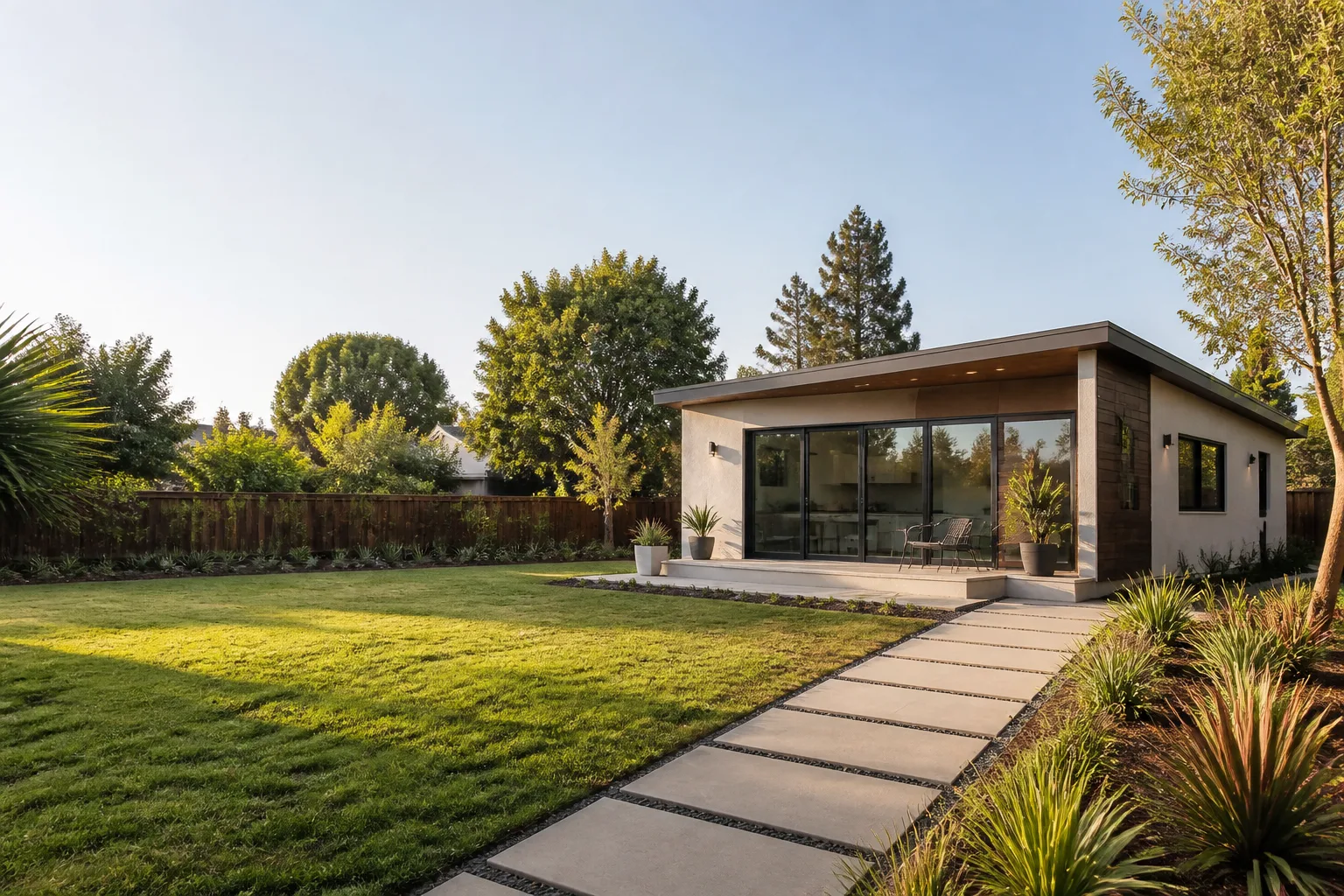
The three main paths are prefab, modular, and conventional stick-built. Prefab and modular ADUs, from manufacturers like Abodu and Plant Prefab, arrive as a set of panels or modules that a certified installer assembles on site. They work well on lots with clear crane or truck access and where the homeowner wants a compressed construction schedule and a manufacturer-backed shell warranty. The tradeoff is that Thousand Oaks plan check still applies, and the site work, foundation, utility, and permits are still handled locally. The manufacturer builds the box; the licensed local contractor makes it legal on your lot.
Conventional construction, using materials like James Hardie siding, gives you more flexibility on a sloped or constrained lot where a module cannot maneuver. It also allows the ADU to match the main house in ways a Tuff Shed or other prefab path might not, which matters in neighborhoods with design review overlays. The tradeoff is a longer build cycle and more days of trade coordination.
We work with all of these paths, because no single method fits every Thousand Oaks parcel. The conversation we have with a homeowner starts with the lot, the budget, and the schedule, then we match the method to those facts. That is the order that works. A contractor who only sells one platform is not matching the method to your lot; they are matching your lot to their inventory.
The Full Hiring Checklist for an ADU Contractor in Thousand Oaks
Here is the vetting sequence in order. Run every step and do not skip one because the contractor is charming.
- Run the CSLB check. Confirm the license is active, verify the classification covers ADU work, and check for workers’ compensation coverage. Three minutes.
- Ask who pulls the permit. The contractor’s name and license number should be on it. If the answer is yours, treat that as a no.
- Get the written price. Demand a line-item bid with the allowance section, exclusions paragraph, price-change triggers, and milestone-based payment schedule all filled in. No verbal estimates.
- Call two references. Ask about schedule slips and change orders. Then drive by the completed job.
- Verify the build method. Ask which method the contractor has built before and whether the current bid matches your lot’s access and slope conditions.
- Get the guarantee in writing. If there is no written workmanship guarantee, ask why. If the answer is vague, move on.
That is the whole process. It does not require a construction background. It requires the discipline to ask the same questions on every call and to walk away when the answer is wrong.
Common Mistakes to Avoid
- Treating the lowest bid as the best bid. In the Thousand Oaks ADU market, the low bid is usually the one with the most omissions. That $40,000 you think you saved becomes a $55,000 change order in month two.
- Skipping the CSLB check because the contractor was referred. A referral does not protect you from a suspended license or an expired workers’ comp policy. Run the check every time.
- Signing a contract with a vague scope. A contract that says “ADU per plans” without attaching the plans and a line-item budget is not a contract; it is an invitation to argue later.
- Paying a large up-front deposit. California law caps the down payment for home improvement contracts at 10% of the project price or $1,000, whichever is less. A contractor asking for 30% up front is outside the law. Do not fund their working capital.
- Assuming the permit is the contractor’s problem after you sign. If your name is on the permit, you carry the liability. Confirm permit ownership before work starts, not after the inspector shows up.
- Not asking about the written guarantee. Most contractors in the ADU space do not offer a written one-year guarantee. Requiring one separates the builders who will fix their mistakes from the ones who hope you never call back.
When to Call a Professional
Call a professional when the scope involves a permitted structure, which every ADU in Thousand Oaks does. That includes any detached unit, garage conversion, or attached addition that adds living space. If you are unsure whether your project triggers a permit, call the city’s Building & Safety Division and ask, then call the contractor. Do not start a project that will need a permit without a licensed builder attached, because unpermitted work becomes your legal and financial problem at resale, insurance renewal, or an inspector visit.
Fielding ADU Thousand Oaks offers free written estimates in Thousand Oaks and the surrounding Conejo Valley, including the Fielding ADU Thousand Oaks home service area. Call (805) 309-3020 and you will reach a live person, whether it is noon or midnight. We will walk the lot, review the parcel, and put the price in writing before you commit to anything.
Frequently Asked Questions

In the Thousand Oaks market, a garage conversion typically runs $90,000 to $160,000, while a detached 600 to 800 square foot ADU runs $220,000 to $350,000 before permit fees, depending on site conditions, build method, and finish level. Prefab and modular options such as Abodu or Plant Prefab can shift both schedule and cost depending on lot access. Call (805) 309-3020 for an exact written quote based on your parcel – estimates are free.
A standard detached ADU in Thousand Oaks takes 6 to 10 months from plan set to final inspection, with plan check at the city taking 8 to 12 weeks before construction begins. Prefab builds can shorten the on-site construction phase to under 4 months once the foundation and utilities are done. The schedule depends heavily on your lot, the build method, and how quickly the city processes the permit, which is why we put the timeline in writing alongside the ADU cost breakdown for Thousand Oaks homeowners in 2026.
Yes, every garage conversion in Thousand Oaks requires a building permit from the city, and the conversion must meet current code for insulation, electrical, ceiling height, and egress windows. A conversion done without a permit creates a legal issue at resale and can be flagged during an insurance inspection. Our Garage Conversion Contractor in Thousand Oaks page covers this in detail, and we pull the permit in our name on every job.
Ask who pulls the permit and whose name goes on it, whether the price is fixed in writing before work starts, which build methods the contractor has actually completed, whether the guarantee is written, and for two references you can call. Those five questions filter out most of the bad hires in the Thousand Oaks market without needing any construction knowledge.
Yes, Thousand Oaks permits prefab and modular ADUs as long as the structure meets California building code and city plan check requirements. The key is that the site work, foundation, utility connections, and permit must still be handled by a licensed local contractor, which is where we work with platforms like Plant Prefab and Abodu; see our Seasonal ADU Care for Thousand Oaks: Year-Round Homeowner’s Guide for ongoing maintenance after move-in.
No, a room addition that is attached to the main house and does not include a separate kitchen follows a different permit path than a detached ADU, though both require building permits in Thousand Oaks. The differences matter for setbacks, utility connections, and cost per square foot. For the specifics, see our Room Addition Contractor in Thousand Oaks page, and call (805) 309-3020 for a written estimate on your addition.
The Bottom Line
Hiring an ADU contractor in Thousand Oaks is a vetting process, not a shopping process, and the vetting is repeatable. Check the CSLB license and classification. Confirm who pulls the permit and carries the liability on the city’s paperwork. Read the bid for what is missing and demand the exclusions in writing. Call two references and ask about schedule slips and change orders. Get the guarantee written into the contract, not promised in the meeting. Then, and only then, compare numbers. Fielding ADU Thousand Oaks builds to the Garrison Standard: ADU Builders in Thousand Oaks with a written price before work starts, a written one-year guarantee, and a live person on the phone at any hour. Call (805) 309-3020 for your free written estimate.
Written by Reed Calloway, Owner at Fielding ADU Thousand Oaks, serving Thousand Oaks since 2006. Explore more guides & resources.