Last updated October 15, 2026
ADU Cost Breakdown: The Thousand Oaks Homeowner’s Reference for 2026
The $350-per-square-foot figure that circulates in Thousand Oaks ADU conversations is a foundation-to-roof construction cost. It does not include permits, utility connections, grading, or design, which together routinely add $40,000 to $80,000 to a project before a framer shows up. If you bring that number to a lender or a savings plan, you will be short. This guide breaks the real cost of an ADU in Thousand Oaks into the phases where money actually leaves your account, so you can budget against the number on the final invoice, not the number on a brochure. For a broader overview, see our The Complete Guide to ADU in Thousand Oaks.
Quick Answer
A detached ADU in Thousand Oaks typically costs between $320 and $450 per square foot all-in for 2026, meaning a 500-square-foot one-bedroom unit lands between $160,000 and $225,000, while a 1,000-square-foot two-bedroom unit runs $320,000 to $450,000. Garage conversions run lower, typically $180 to $280 per square foot, because the foundation, framing, and roof already exist. Every number shifts based on site conditions, utility trenching distance, and finish level, which is why a written line-item estimate beats a square-foot guess every time.
Table of Contents
- Pre-Construction Costs: What You Pay Before a Shovel Touches Dirt
- Site Work Variables: Grading, Trenching, and Fire Access on Thousand Oaks Lots
- Construction Costs by Trade: Where the Labor Dollars Go
- Prefab vs. Conventional Builds: What the Method Does to the Number
- The $280/sqft vs. $420/sqft Bid Gap: What You’re Actually Paying For
- How a Written Fixed-Price Contract Protects Your Budget
- Common Mistakes to Avoid
- When to Call a Professional
- Frequently Asked Questions
- The Bottom Line
Pre-Construction Costs: What You Pay Before a Shovel Touches Dirt
Before any framing begins, a Thousand Oaks ADU carries five to seven distinct pre-construction line items. Homeowners who skip this phase in their budgeting are the ones who get surprised by a $12,000 bill for drawings and permits they never planned for. Here is the breakdown for 2026.
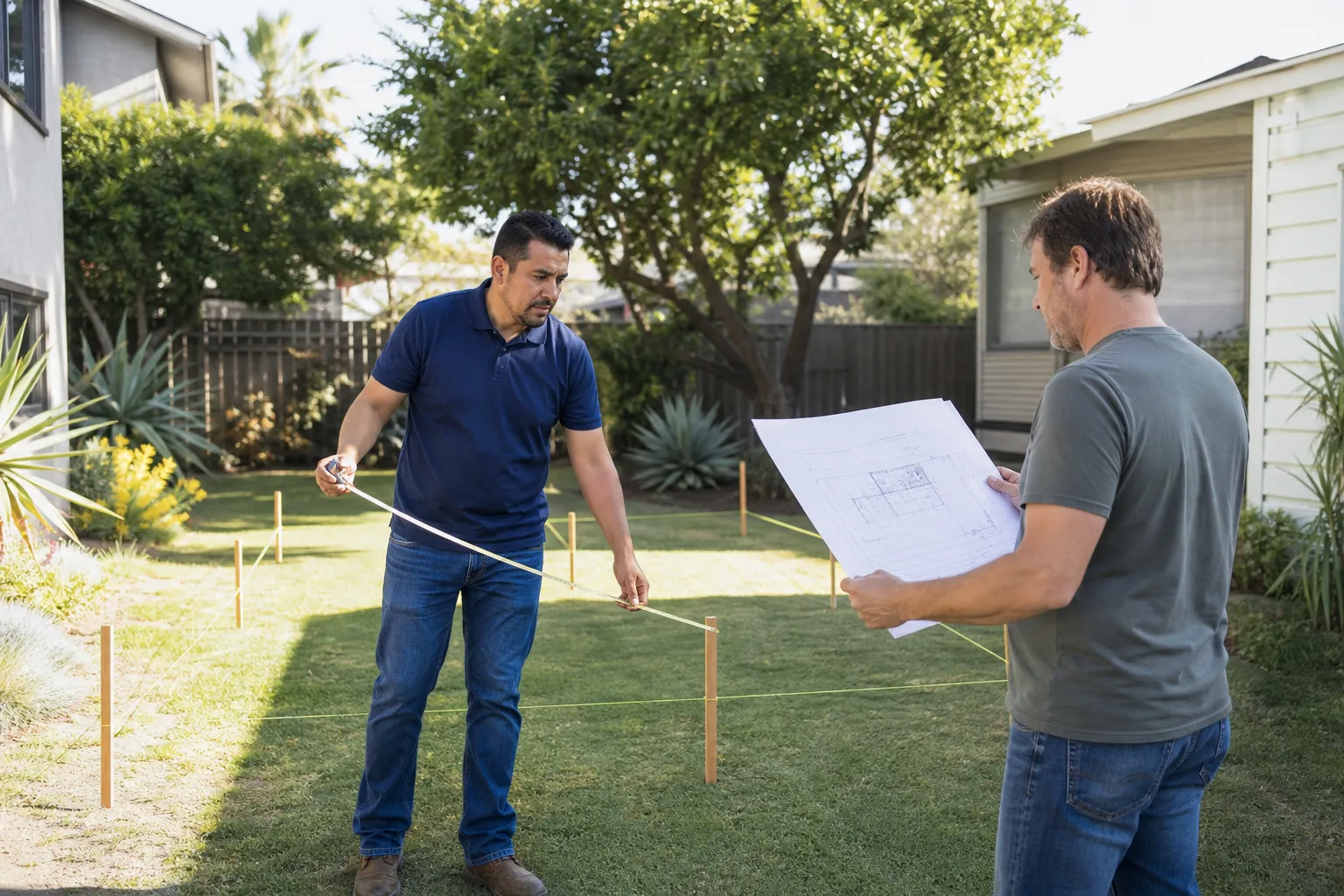
Site survey and property line verification typically runs $800 to $1,500 in Thousand Oaks. The survey establishes exactly where your lot lines sit, which matters because the city requires specific setbacks from those lines. A soils report, required on some hillside lots and most lots with expansive clay, adds $2,500 to $5,000. Thousand Oaks has areas of moderately expansive soil, particularly in the northern hills, and the city’s building department will call for a geotechnical report when the site suggests it.
Architectural drawings for an ADU run $8,000 to $18,000 depending on whether you use a design-build firm, an independent architect, or a prefab company whose plans are already engineered. Title 24 energy compliance, which the state requires on every new dwelling, adds another $800 to $1,500 for the report and the mandated solar-ready or solar-installed configuration. A 500-square-foot ADU in Ventura County under the 2026 energy code will require a small solar photovoltaic system in nearly every case.
Permit fees in Thousand Oaks for an ADU run $6,000 to $14,000 depending on valuation and square footage. The city publishes its fee schedule, and the number includes plan check, building permit, electrical, plumbing, and mechanical permits, plus school district fees. Thousand Oaks has not adopted the most aggressive ADU fee incentives that some cities have, so expect the full schedule.
When Reed Calloway walks a Thousand Oaks lot for a Fielding estimate, the first thing we price is the pre-construction stack, because that is the money you spend before you see a single wall. Every one of these items goes in writing before any work starts.
Site Work Variables: Grading, Trenching, and Fire Access on Thousand Oaks Lots
Site work is where two identical ADUs on two different Thousand Oaks lots can diverge by $30,000 or more. The dirt under the unit, the distance to the main sewer line, and the fire department’s access requirements drive this variance.
Grading a flat lot in central Thousand Oaks might cost $3,000. Grading a sloping lot in the hills above Lynn Road, where you need retaining walls and drainage controls, can run $25,000 to $40,000 before the foundation forms go in. The grade dictates whether you build on a standard slab, a raised foundation, or a combination with stepped footings.
Utility trenching is the quiet budget killer. If your ADU sits 30 feet from the main sewer lateral and the electrical panel, the trenching cost is modest, maybe $4,000 to $7,000. If the unit sits 120 feet from the house, across a landscaped yard that has to be restored, that number can climb to $15,000 or more. Sewer line depth matters too, because Thousand Oaks lots in the older Conejo Valley tracts often have mains that sit deeper than newer developments, which adds excavation hours.
Fire access requirements in the wildland-urban interface zones change the driveway and hardscape math. Thousand Oaks has mapped Very High Fire Hazard Severity Zones, and an ADU in those zones may require a wider access path, a turnaround, or non-combustible fencing. Those requirements add cost and, in some cases, shrink the buildable area of the lot. The city’s fire marshal reviews this during plan check, and the requirements are not negotiable.
A competent Thousand Oaks contractor starts the estimate with the site, not the building. The building is predictable. The dirt is not.
Construction Costs by Trade: Where the Labor Dollars Go
The construction phase breaks into trades, and each one bills against the project in a predictable sequence. In Ventura County in 2026, skilled trade labor rates have settled into a range that makes the following line items realistic for a standard detached ADU.
- Foundation: $12,000 to $28,000 depending on slab vs. raised and soil conditions
- Framing: $35,000 to $70,000 for a 500 to 1,000 square foot unit, including lumber package
- Roofing: $8,000 to $18,000 for composition shingle or standing seam on a small footprint
- Mechanical, Electrical, Plumbing (MEP): $28,000 to $55,000, with the panel upgrade and sewer connection being the swing items
- Insulation and Drywall: $8,000 to $15,000
- Windows and Exterior Doors: $6,000 to $14,000 depending on count and glazing spec
- Interior Finishes: $20,000 to $45,000 for flooring, cabinetry, countertops, tile, paint, and fixtures
These ranges assume code-minimum to mid-grade finishes. A custom kitchen with stone tops and a tile shower pushes the finish line item toward the top of the range or beyond. The trades do not bid per square foot. They bid the specific scope, and the General Contractor assembles those bids into the number you see. That is why the per-square-foot figure is an output of the estimate, not an input.
Fielding works with the trade base we know in Thousand Oaks and the surrounding Conejo Valley. We’ve built enough units on these lots to know what a fair bid looks like, and what a bid with hidden holes looks like. Browse more guides & resources on budgeting, permitting, and build methods. The line items above are the ones you should see itemized in any legitimate written estimate.
Prefab vs. Conventional Builds: What the Method Does to the Number
The build method changes the cost structure, not just the cost. Conventional stick-built ADUs price like the trade breakdown above: materials delivered to the site, labor performed on the site, schedule measured in months. Prefab and modular ADUs shift much of that labor into a factory, which changes both the price and the schedule.
Prefab units from companies like Plant Prefab and Abodu typically land in the $300 to $450 per square foot range for the unit itself, plus site work, foundation, and utility connections that stay on your lot. The factory price includes most finishes, which is why the comparison to conventional construction is not apples to apples. A Plant Prefab unit arrives with drywall hung, tile set, and cabinetry installed. A conventional build prices those trades separately.
What prefab saves you is schedule time and the coordination risk of managing six trades sequentially on your property. What it costs you is flexibility. The plans are engineered and largely fixed, which means a Thousand Oaks hillside lot with unusual topography or fire-access constraints may not accept a standard prefab footprint without modification. Some platforms handle that better than others, and we have the working relationships to know which one fits a given lot.
Tuff Shed-style structures occupy the bottom of the cost range. A finished Tuff Shed converted to a small studio ADU can come in under $100,000 total when the site conditions cooperate, but it is a smaller unit with a simpler finish package. James Hardie siding shows up on both conventional and prefab builds, and it is the right call in Thousand Oaks because it holds paint longer and resists the dry-season sun better than wood lap siding.
The decision between conventional and prefab is a budget and schedule decision. A written price that compares both methods on your specific lot is the only honest way to make it.
The $280/sqft vs. $420/sqft Bid Gap: What You’re Actually Paying For
When one Thousand Oaks contractor bids $280 per square foot and another bids $420 per square foot for what looks like the same 600-square-foot ADU, the difference is not profit margin. It is scope, risk allocation, and finish level. Here is what sits inside that gap.
- Allowance depth. The $280 bid typically carries thin allowances for finishes, often $8 to $12 per square foot for flooring, $5,000 for cabinetry. The $420 bid carries realistic allowances or specs actual products. When the allowances run out, the cheaper bid sends a change order.
- Site condition assumptions. The cheaper bid often assumes a flat lot with a short utility run. If your lot is not that, the change order comes during excavation, when you are already committed.
- Drawings and engineering quality. The $420 bid usually includes a full structural engineering package and Title 24 compliance. The $280 bid may assume the owner pays for those separately, which means the comparison was never equal.
- Trade quality. Labor rates in Ventura County vary by crew experience. A framing crew that hits its tolerances and a finish crew that does clean trim work bill higher. The cheaper bid is often buying the crew the better contractor passed on.
- Schedule honesty. The cheaper bid often assumes an aggressive timeline that does not account for Thousand Oaks plan check turnaround or fire marshal review. The delay shows up later as carrying costs, not change orders.
The better question than “why is the cheap bid cheap” is “what does the expensive bid include that the cheap bid left out.” Ask every bidder to line-item their allowance schedule and their site assumptions. The one who hands you a written, itemized scope is the one whose number you can hold.
How a Written Fixed-Price Contract Protects Your Budget
The contract type determines whether your ADU budget is a ceiling or a suggestion. Thousand Oaks homeowners who sign allowance-based contracts are signing up for a number that moves when material prices move. A written fixed-price contract puts the risk of misestimation on the contractor, where it belongs.
Thousand Oaks sits inside a volatile materials market. Lumber, concrete, and electrical components have swung 15 to 25 percent within single quarters in recent years. An allowance-based contract passes those swings to you in the form of change orders. A fixed-price contract means the number you approve on day one is the number on the final invoice, full stop.
The Garrison Standard exists because Reed Calloway has seen too many Thousand Oaks homeowners get moved at the door. Every Fielding ADU project gets a written price before any work starts. The price is itemized by phase and trade, not by square foot, because the square foot is not a price and never was. If the work fails within 365 days, we come back and correct it at no charge. That part is written down too, because a guarantee you cannot read is a guarantee that does not exist.
What matters on signing day is not the logo on the truck. It is whether the contract names the scope, prices the scope, and binds the price. Anything less is a request for trust you have no reason to give.
Common Mistakes to Avoid
- Budgeting from the per-square-foot number. The square-foot figure excludes pre-construction, site work, and utility connections. Use a line-item estimate instead.
- Skipping the soils report on a hillside Thousand Oaks lot. The building department may require it anyway, and discovering expansive soil after the foundation bid wastes weeks and money.
- Ignoring fire-access requirements until plan check. A required turnaround or widened driveway can consume 300 square feet of buildable yard and add $15,000 in hardscape.
- Signing an allowance-based contract without reading the allowance schedule. Thin allowances are how a cheap bid becomes an expensive build. Read every allowance line and ask what product it buys.
- Overbuilding finishes for the rental market. If the ADU is a rental, spec durable surfaces and mid-grade fixtures. Custom stone and high-end tile do not return enough rent in Thousand Oaks to justify the cost.
- Not confirming the panel capacity before the MEP bid. A 100-amp panel cannot carry a full ADU. The panel upgrade is a $4,000 to $8,000 line item that should appear in the first estimate, not as a surprise.
- Hiring the low bid without comparing scope. The low bid usually assumes the easy site and the thin finishes. The comparison that matters is line item to line item.
When to Call a Professional
Call a professional when you have a lot, a budget range, and a rough idea of the unit you want, but no written price. That is the point where guessing stops and a real estimate starts. Call when the lot has any slope, when the sewer line runs long, or when the property sits in a fire hazard zone, because those are the conditions that make square-foot pricing useless. Call when you have a bid in hand that seems low and you want a second set of eyes on the allowance schedule and site assumptions. Fielding ADU Thousand Oaks offers free estimates in Thousand Oaks. Call (805) 309-3020 and ask for the written, itemized number. Reed Calloway has been doing this since 2006, and the price still goes in writing before any work starts.
Frequently Asked Questions
A detached ADU in Thousand Oaks runs $320 to $450 per square foot all-in for 2026, which puts a 500-square-foot unit at $160,000 to $225,000 and a 1,000-square-foot unit at $320,000 to $450,000. Garage conversions run $180 to $280 per square foot because the structure already exists. Call (805) 309-3020 for a written line-item estimate on your specific lot.
The biggest hidden cost is utility trenching, which can run from $4,000 to more than $15,000 depending on the distance from the ADU to the main sewer lateral and electrical panel. Pre-construction costs including drawings, Title 24 reports, and permits add $20,000 to $35,000 more before construction starts.
Prefab ADUs from companies like Plant Prefab and Abodu typically land in a similar per-square-foot range as conventional construction once site work and foundation are included, but they usually finish faster and carry less coordination risk. A Tuff Shed-style converted structure can be the cheapest path for a small studio, often under $100,000 total.
Not if the contract is written as a fixed price. A fixed-price contract locks the number you approve on day one, assuming the scope does not change. Allowance-based contracts pass material and labor swings to you. Fielding writes fixed prices before any work starts, every time.
The Thousand Oaks building department requires a soils report on hillside lots and lots with expansive clay, which covers much of the northern part of the city. The report costs $2,500 to $5,000 and determines the foundation design, so it is not a corner worth cutting.
Plan check in Thousand Oaks typically takes 4 to 8 weeks depending on current volume and fire marshal review. Construction for a conventional detached ADU runs 8 to 14 months from permit issuance to final inspection. Prefab units can compress the on-site phase to 3 to 6 months after site work is complete.
The Bottom Line
An ADU in Thousand Oaks costs what the site, the scope, and the contract say it costs, not what a square-foot figure suggests. The all-in number for a detached unit runs $320 to $450 per square foot in 2026, with pre-construction and site work driving the variance. Get the price in writing, itemized by phase, before any work starts. Read the allowance schedule if there is one. Confirm the panel, the trenching distance, and the fire-access requirements before you commit. The homeowners who get burned are the ones who budget from the brochure number and sign the cheapest bid. The homeowners who finish clean are the ones who hold a written price and a written guarantee. Fielding ADU Thousand Oaks works under ADU Builders in Thousand Oaks, and every estimate starts the same way: walk the lot, price the site, write the number down. Call (805) 309-3020 for a free estimate. For more on what we do across the Garrison Partners family, see our Fielding ADU Thousand Oaks home page, our Garage Conversion Contractor in Thousand Oaks guide, or our Room Addition Contractor in Thousand Oaks reference.
Written by Reed Calloway, Owner at Fielding ADU Thousand Oaks, serving Thousand Oaks since 2006.