Last updated October 15, 2026
DIY vs Professional ADU: The Thousand Oaks Homeowner’s Decision Guide
California law hands every homeowner a tempting shortcut: pull your own ADU permit, call yourself an owner-builder, and skip the general contractor’s fee. On paper, that move saves 15 to 25 percent of the project cost. What the permit application does not tell you is that Ventura County lenders, appraisers, and title companies treat an owner-built accessory dwelling unit differently than a contractor-built one. That difference sits dormant until the day you refinance, pull equity, or put the house on the market in Thousand Oaks. This guide walks through the real math, the legal exposure, and which parts of an ADU actually make sense to do yourself; for ongoing support, see our Seasonal ADU Care for Thousand Oaks: Year-Round Homeowner’s Guide.
Quick Answer
For most Thousand Oaks homeowners, hiring a licensed ADU contractor is the financially safer choice even when you have the skills to build it yourself. The deciding factors are permit liability, lender and appraiser treatment of owner-built units, and resale title encumbrance. DIY savings of $40,000 to $80,000 in labor can evaporate at refinance or sale if the ADU was not built under a licensed contractor’s permit history.
Table of Contents
- What California’s Owner-Builder Permit Declaration Actually Commits You To
- How Lenders and Appraisers Treat an Owner-Built ADU
- The Permit Inspection Sequence You Will Manage Alone
- Which Scopes Are Genuinely DIY-Feasible After Rough-In
- The Honest Cost Comparison: Labor Savings vs. Risk
- Common Mistakes to Avoid
- When to Call a Professional
- Frequently Asked Questions
What California’s Owner-Builder Permit Declaration Actually Commits You To
When you sign an owner-builder permit application in Thousand Oaks, you are declaring under penalty of perjury that you will perform the work yourself or hire licensed subcontractors, that you will not sell the property for at least one year after completion of the work, and that you accept full liability for the construction. The one-year resale restriction is California Health and Safety Code Section 19825, and it is the first thing a title company pulls when you list the house.
The commitment goes further than the resale clock. As an owner-builder, you are the employer of record for every worker who sets foot on the site. That means workers’ compensation coverage, payroll taxes, and liability exposure sit on your homeowner’s insurance policy. Most homeowner’s policies in Thousand Oaks carry a $300,000 liability limit and exclude construction activity entirely. When a framing nail punctures a sub’s hand on your property, you are not protected by a contractor’s general liability policy.
The liability follows the building, not the builder. If you sell within five years and the new owner discovers a construction defect, they can pursue you personally. A licensed contractor’s insurance and bond are done at that point. Your exposure is not. California Civil Code 896 lists the functional standards an ADU must meet, from window flashing to roof runoff. Violate any of them as an owner-builder and you carry the correction cost.
We have walked through this with Thousand Oaks homeowners who pulled permits in good faith and then watched the permit board stall. For more context on what a full ADU project entails, see our ADU Builders in Thousand Oaks page.
How Lenders and Appraisers Treat an Owner-Built ADU
Here is where the DIY calculation gets uncomfortable. When you apply for a cash-out refinance on a Thousand Oaks property with an ADU, the underwriter orders an appraisal. The appraiser verifies the ADU was permitted and completed legally. If the permit history shows an owner-builder, the underwriter will ask additional questions. Is the ADU legal and permitted? Yes. Was it built by a licensed contractor? No. Some lenders will still finance the property. Others will not, particularly portfolio lenders and credit unions in Ventura County that have tighter underwriting standards than Fannie Mae or Freddie Mac.
Fannie Mae’s selling guide does not explicitly require a contractor-built ADU, but it does require that the ADU be legal and compliant with local code. What it does not guarantee is how the appraiser will value the unit. An appraiser comparing your property to comps in Thousand Oaks cannot always verify the construction quality of your owner-built ADU. A contractor-built ADU has a permit history that names a licensed entity, which an appraiser can cross-reference. An owner-built ADU has your name and your word. That asymmetry shows up in the valuation.
The practical outcomes we see in Thousand Oaks:
- Refinance denials: Some lenders decline to underwrite properties with owner-built ADUs completed within the last five years.
- Lower appraised value: Even when financing goes through, the ADU may be valued below its replacement cost because the appraiser lacks verifiable construction documentation.
- Rate adjustments: A lender that approves the loan may apply additional risk pricing, adding a quarter to half a point to the rate.
- Sale financing complications: A buyer using an FHA or VA loan may hit a wall if the lender objects to the owner-built ADU. That narrows your buyer pool on the day you sell.
No amount of construction skill changes how an underwriter reads a permit file. The distinction is structural, not cosmetic.
The Permit Inspection Sequence You Will Manage Alone
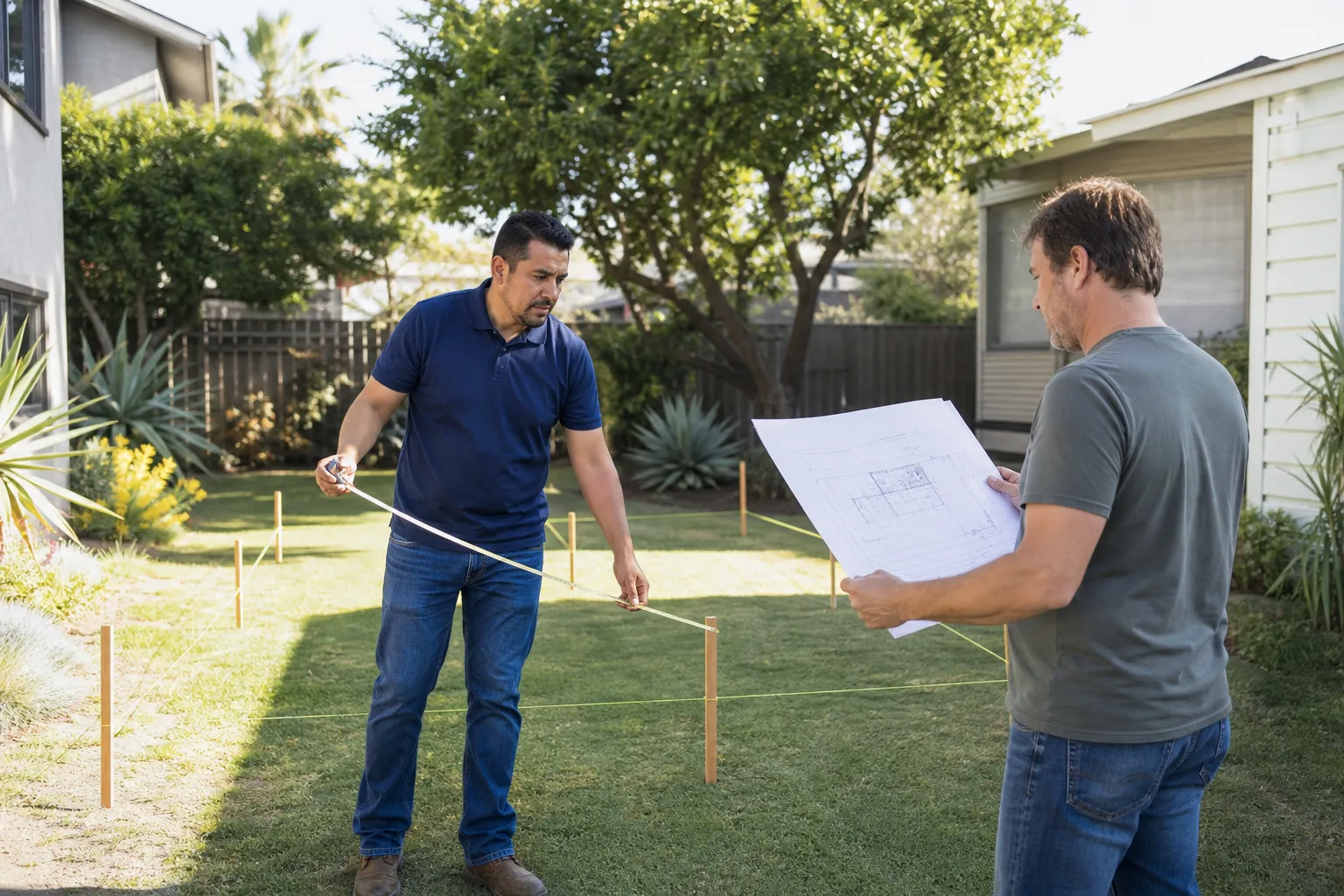
When you file as an owner-builder in Thousand Oaks, you inherit the entire inspection calendar. The City of Thousand Oaks Building and Safety Division schedules inspections, but nobody schedules them for you. You request the inspection, you stand on-site during the visit, you answer the inspector’s questions, and you fix whatever fails. Miss a request window and the project sits.
The inspection sequence for a typical detached ADU runs like this:
- Foundation and set-back inspection: Before concrete is poured, the inspector verifies the formwork, rebar, and property line setbacks. Fail this and you are pouring twice.
- Underfloor and plumbing rough-in: Drains, supply lines, and any in-slab electrical conduit must be visible and checked before the slab covers them.
- Framing inspection: The inspector looks at shear walls, hold-downs, roof framing, and fire-blocking. Ventura County’s seismic requirements mean this inspection is detailed.
- Electrical rough-in: All wiring, boxes, and panel connections must be visible. This is where owner-builders most often fail, usually on grounding and arc-fault requirements.
- Mechanical rough-in: Ducting, venting, and any gas line work must be checked before insulation goes in.
- Insulation inspection: The R-value in the walls and ceiling must match the energy calculations filed with the permit.
- Drywall and fire-taping final: The inspector verifies fire separation from the main dwelling and any garage.
- Final inspection and certificate of occupancy: Every prior correction must be closed. Only then can the ADU be legally occupied or rented.
A failed inspection is not a warning. It is a stop-work order until the correction is made and the inspection is rescheduled. In Thousand Oaks, the reschedule window is typically one to two weeks. A contractor absorbs that delay into the schedule. An owner-builder absorbs it into their evenings, weekends, and PTO. Two failed inspections can add a month to a project that a licensed crew would finish on a calendar.
For a sense of how this plays out on a garage conversion, where existing structure complicates the sequence, see our Garage Conversion Contractor in Thousand Oaks page.
Which Scopes Are Genuinely DIY-Feasible After Rough-In
The honest answer: once the permitted rough-in is complete and the building envelope is closed, certain finish scopes are approachable for a capable homeowner. The key distinction is that licensed trade work inside an ADU means work on load-bearing structure, electrical panels and branch circuits, gas lines, and plumbing drain-waste-vent systems. California law does not allow an owner-builder to perform work outside the owner-builder scope if it requires a specialty license, unless the owner performs it personally and lives on the property.
But there is a narrow band of work where a Thousand Oaks homeowner can save real money without touching code-critical systems:
- Interior paint and finish carpentry: Trim, baseboard, and crown molding require patience and a miter saw, not a license.
- Cabinet assembly and installation: Pre-fabricated cabinets from a box store install with shims, levels, and screws.
- Flooring: Luxury vinyl plank and laminate are genuinely DIY-friendly. Tile is not, unless you have a wet saw and a steady grid.
- Fixtures: Swapping a faucet, towel bar, or light fixture trim kit is within reach for most homeowners. But note that changing a light fixture means working inside a junction box. If the box was not installed for the fixture, call an electrician.
- Landscape and hardscape around the ADU: Permeable pavers, gravel paths, and drought-tolerant plantings in the Thousand Oaks climate are all on the table.
What is not DIY-feasible after rough-in: panel upgrades, any gas line work, roof penetrations, window and door replacement on a load-bearing wall, and any modification to shear wall. Ventura County seismic requirements under the 2022 California Building Code treat shear wall as structural. Drill one unplanned hole and the inspector can flag the entire wall.
Where prefab and modular platforms fit: companies like Boxabl and Dvele ship units with factory-completed electrical and plumbing that arrive with third-party inspection reports. A homeowner fresh off an owner-builder permit can have a Boxabl unit set on a foundation and connected by licensed trades. The set and connect work is outside the DIY lane, but it is a fraction of the build time of a stick-frame ADU. We have installed units from both Boxabl and Dvele in Thousand Oaks and found the engineering documentation to be consistently strong.
The Honest Cost Comparison: Labor Savings vs. Risk
Let us put numbers on the table. In Thousand Oaks, a 500-square-foot detached ADU built to code by a licensed contractor currently runs $275 to $425 per square foot, all in. That is $137,500 to $212,500 for the finished unit. A garage conversion of the same size runs $175 to $300 per square foot, or $87,500 to $150,000, because the shell already exists. You can see the range on our Room Addition Contractor in Thousand Oaks page for comparison.
An owner-builder who does some finish work and hires subs for rough-in might land at $200 to $300 per square foot. Call it $100,000 to $150,000 for the same 500-square-foot detached unit. The gross savings: $37,500 to $62,500. That is real money.
Now subtract what the savings actually costs:
- Your time: Managing subs, scheduling inspections, and doing finish work on a 500-square-foot ADU takes 400 to 700 hours of owner time across the project. At a Thousand Oaks homeowner’s typical earning rate, that time is worth more than the savings.
- Carrying costs: A contractor finishes a detached ADU in 6 to 10 months. An owner-builder typically runs 12 to 18 months because inspections wait, subs no-show, and weekends have weather. Every extra month is an extra month of construction loan interest or lost rental income.
- Corrective work: The most common failed-inspection items for owner-builders are electrical grounding, shear nailing patterns, and window flashing. Each correction costs $500 to $2,000 in rework, and rework is rarely budgeted.
- Warranty exposure: A licensed contractor in California carries a statutory 10-year latent-defect liability and, in our case, a written one-year workmanship guarantee. An owner-builder carries the same 10-year latent-defect liability with zero warranty coverage from anyone but themselves.
- Refinance hit: Even a 0.25 point rate adjustment on a $600,000 cash-out refinance is $1,500 per year in extra interest. Over the life of the loan, that can eclipse the entire labor savings.
The honest position is this: if your goal is to maximize total project savings and you intend to hold the property for a decade or more, an owner-builder finish-out can work. If your goal is to protect resale value and refinance access, the professional route is cheaper in the long run.
On a related note, if you are comparing build methods, we work with modular platforms like Cover for contemporary detached units. Cover’s steel-frame panelized system ships with pre-cut openings and pre-wired chases, which simplifies the rough-in inspection considerably. The choice between conventional lumber and a Cover panel system is a budget and timeline decision, not a quality decision.
Common Mistakes to Avoid
- Signing the owner-builder declaration without reading the one-year resale restriction. California Health and Safety Code 19825 means you cannot sell for a year after completing the work. If a family situation forces a sale sooner, the transaction can stall in escrow.
- Assuming homeowner’s insurance covers construction injury. It does not. An uninsured worker injured on your ADU site can file a claim against your personal assets. A licensed contractor carries workers’ compensation. You likely do not.
- Hiring an unlicensed subcontractor to save money. In Ventura County, unlicensed work over $500 is a misdemeanor. If the work fails, you have no state licensing board to pursue. You also void any future insurance claim tied to that work.
- Skipping the pre-permit plan check at the City of Thousand Oaks. The plan check catches conflicts with setbacks, height limits, and fire code before you spend money on materials. Skipping it to save two weeks costs two months later.
- Under-budgeting for site work. Grading, drainage, and utility trenching on Thousand Oaks lots with decomposed granite or clay soil run 10 to 20 percent above the building quote. Owner-builders routinely miss this line item.
- Building an ADU that appraises as a workshop. An unpermitted kitchen and bathroom do not magically become legal at resale. If the ADU lacks a permitted kitchen, it is not an ADU to a lender.
- Taking on panel and gas work because a YouTube video made it look clean. A licensed electrician and a licensed plumber are the only people qualified to touch a panel or a gas line. Anyone else is a liability walking through your back gate.
When to Call a Professional
Call a professional if your ADU involves any structural modification, panel upgrade, gas line, or foundation work. Call a professional if you plan to refinance or sell within five years and need clean permit history. Call a professional if you have already had a contractor miss a schedule or move a price and you do not want to repeat the experience as your own project manager. Fielding ADU Thousand Oaks offers free estimates in Thousand Oaks. Call (805) 309-3020 to schedule one, or start with our Fielding ADU Thousand Oaks home page for an overview of how we work.
Frequently Asked Questions
A detached ADU in Thousand Oaks runs $275 to $425 per square foot including permits, site work, and finish-out, so a 500-square-foot unit lands between $137,500 and $212,500. Garage conversions run $175 to $300 per square foot. These are current market ranges from projects we have priced in the area. Call (805) 309-3020 for a written estimate specific to your lot.
Yes, but the owner-builder permit declaration creates a one-year resale restriction and assigns personal liability for any construction defect discovered within ten years. Lenders and title companies in Ventura County flag owner-built units during refinance and sale. The legal right to build your own ADU does not mean the market will treat it the same as a contractor-built unit.
Yes, and this is the smartest version of DIY for most Thousand Oaks homeowners. Licensed contractors handle foundation, framing, electrical, plumbing, and inspections. You take over paint, trim, flooring, and fixtures after final rough-in approval. The permit history names a licensed entity, which protects your refinance position.
A detached ADU built by a licensed contractor takes 6 to 10 months from permit approval to final inspection. A garage conversion runs 4 to 7 months. Owner-built projects typically stretch to 12 to 18 months because inspection scheduling and subcontractor coordination fall on the owner.
Yes. Thousand Oaks requires a building permit for any garage conversion that adds living space, and the conversion must meet California Building Code requirements for insulation, egress, ventilation, and fire separation. An unpermitted garage conversion is not an ADU in the eyes of a lender or an appraiser, regardless of what a listing agent may claim.
Not if the contract is written correctly. We write the price before any work begins, with change orders only if the scope changes at your request. If a contractor will not put the number in writing before you sign, that is your signal to call someone else. Call (805) 309-3020 to get your estimate in writing.
The Bottom Line
The DIY versus professional ADU decision in Thousand Oaks is not about competence. It is about liability, financing, and resale. California gives you the legal right to build your own ADU. Ventura County lenders and title companies do not have to like it, and often they do not. If you plan to hold the property long-term and can manage the inspection calendar, targeted DIY finish work after professional rough-in is a reasonable middle path. If you plan to refinance, rent, or sell within five years, hire the licensed route and keep the permit file clean. The best move is to get a written price and a written guarantee before any work starts, then decide with real numbers on the table. For more guidance, explore our more guides & resources.
Written by Reed Calloway, Owner at Fielding ADU Thousand Oaks, serving Thousand Oaks since 2006.