James Hardie New Detached ADU: The Thousand Oaks Owner’s Guide
We stock and install James Hardie-compatible siding, trim, and structural components for new detached ADUs across Thousand Oaks, and most replacement work lands between $4,800 and $14,500 installed, depending on the surface area, product line, and what failed. We typically begin a James Hardie siding or trim swap within a week of your call, not a month. Most owners discover the problem the same way: a corner board pulls away after a wet winter, a bottom course shows swelling near the sprinkler line, or a HardiePanel seam opens up along the south-facing wall where Thousand Oaks heat cycles run hard from June through September. If you are reading this, you probably already know which board or panel is failing. The question is whether the rest of the envelope is sound, and what it costs to fix it right.
Key Takeaways:
- James Hardie siding and trim on Thousand Oaks ADUs fails most often at grade contact, sprinkler overspray, and unflashed corners, not from manufacturing defects.
- ColorPlus finish carries a 15-year warranty on new HardiePlank, while primed product requires paint and holds its own warranty separate from installation workmanship.
- We write the price before work starts, apply The Garrison Code on every job, and back completed work for a full year in writing.
Which James Hardie Models This Applies To
Our Thousand Oaks crews work with the full James Hardie line, but the three products we install or replace most on detached ADUs are HardiePlank lap siding (5.25-inch and 8.25-inch exposures), HardiePanel vertical siding (4×8 and 4×10 sheets), and HardieTrim boards (4/4 and 5/4 thickness, typically 3.5-inch or 5.5-inch widths). Each has a different failure profile, and matching the right replacement matters. A 5.25-inch HardiePlank board from 2016 will not accept today’s ColorPlus finish batch in a way that blends cleanly without a repaint, which is a compatibility item some owners only discover after a patch job leaves them with a color mismatch. The same is true of HardieTrim: the smooth texture on current production differs enough from older runs that a single replacement board can stand out on a sunlit wall.
On the OEM-versus-aftermarket question, our position is direct. For structural James Hardie siding and trim, we use James Hardie product. There is no aftermarket equivalent we trust for lap siding or vertical panel, because the fiber cement density, edge profile, and fastener behavior are baked into the warranty and the system’s performance. For accessory parts like flashing, weather-resistant barrier, and fasteners, we use proven equivalents such as Tamlyn, GCP, and Siga where they match or exceed the substrate requirement. Reed Calloway has been specifying and installing these systems in Ventura County for over a decade, and the rule on the truck is simple: on a James Hardie envelope, stay in the James Hardie system unless the job calls for something better.
Signs Your James Hardie New Detached ADU Is Failing
- Swelling or delamination at the bottom course. Sidewalk-to-siding contact or sprinkler overspray keeps water against the fiber cement, and in Thousand Oaks clay soils that hold moisture against slab edges, the board eventually absorbs enough to lose form.
- Corner trim pulling away from the wall. We see this on ADUs where the exterior trim was face-nailed without a proper drainage plane behind it, and seasonal expansion here, where temperature swings run 40 degrees between January mornings and August afternoons, works the fasteners loose.
- Visible seam separation in HardiePanel runs. Vertical panel installs live and die by the flashing at horizontal joints, and if the original builder skipped or undercut the flashing, the seam opens and water gets into the wall cavity.
- Finish fading or chalky residue on the south or west elevation. ColorPlus finish ages faster on the exposure side, and if your ADU faces the Conejo Grade sun path, the west wall can look five years older than the other three sides.
- Staining or softness where the siding meets the roof-to-wall junction. Head flashing that was omitted or undersized lets water run behind the top course, and on a detached ADU with a compact eave line, the damage can go unnoticed until the board starts to blister or the interior drywall shows a shadow.
Replacement Cost & What’s Included
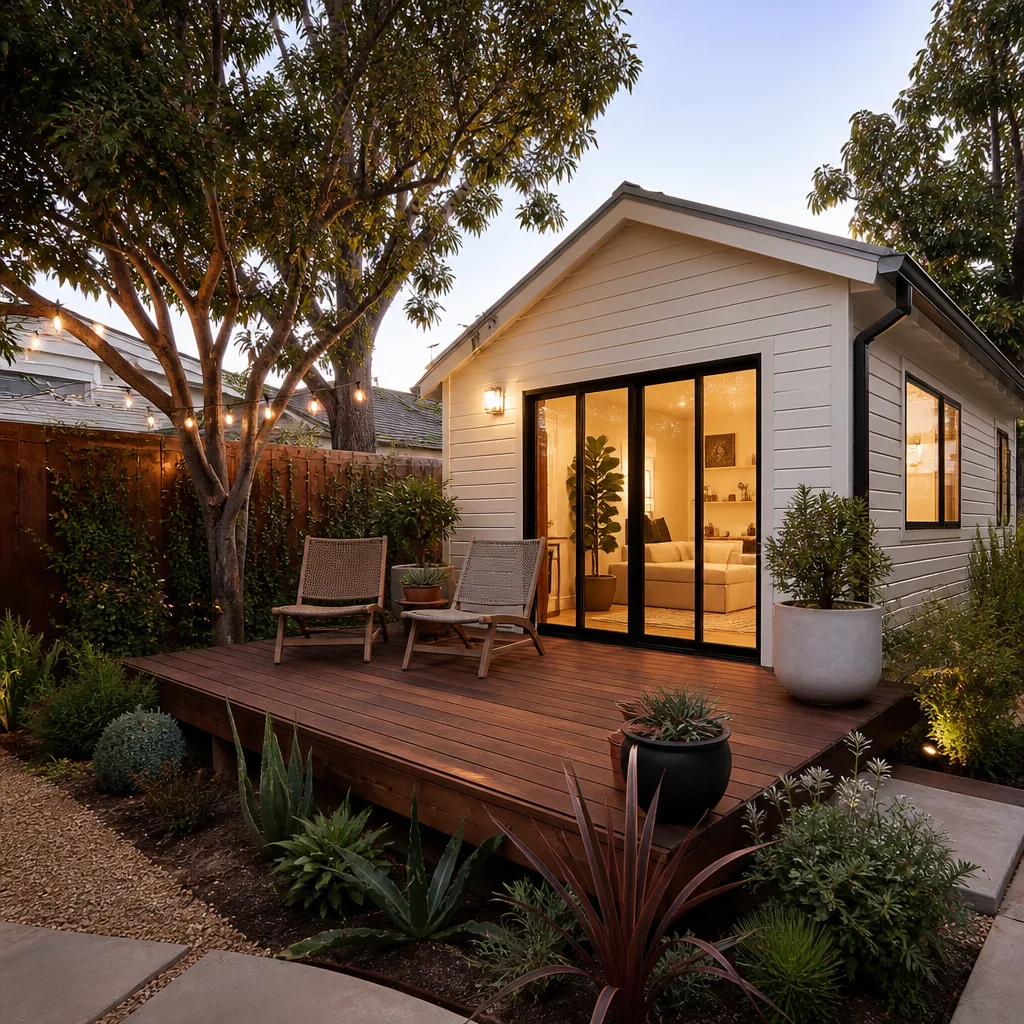
In Thousand Oaks, a focused James Hardie siding or trim replacement on a detached ADU typically runs $4,800 to $14,500 installed, and the range breaks down by scope. Siding a single elevation with HardiePlank and fresh trim boards runs on the lower end; re-siding the entire structure with full weather barrier, flashing upgrades, and paint-grade finish runs toward the top. The biggest drivers are access (a second-story ADU wall or a narrow side setback pushes labor), how much of the underlying water management layer needs correction, and whether any framing repair is hiding behind the failed board.
Our written price includes materials, labor, flashing, fasteners, and disposal. It does not include permit fees, which the City of Thousand Oaks applies on a project-specific basis, or any structural repair we uncover and show you in writing before touching it. Every James Hardie replacement we perform is backed by the manufacturer’s product warranty where applicable and our own 365-Day Done Right Promise on workmanship. If the work fails inside a year, we come back and correct it at no charge.
Here is how a typical replacement scope lines up:
- Single-elevation HardiePlank replacement with trim and paint: $4,800 – $7,200
- HardiePanel seam repair with new flashing and touch-up: $2,400 – $4,000
- Full ADU re-side with HardiePlank, weather barrier, and trim: $10,500 – $14,500
- Corner trim replacement with proper drainage plane behind it: $1,800 – $3,200
DIY or Call Us?
Siding replacement is not a high-tension spring or a live electrical panel, so an experienced homeowner with the right tools can remove and replace a single HardiePlank board safely. The honest split is this: you can inspect for the failure source yourself (sprinkler heads pointed at the wall, missing kickout flashing at the roof corner, soil or mulch touching the bottom course), and fixing those items prevents the next failure. Where DIY goes wrong is when the first board comes off and the water damage behind it is bigger than the board, which is exactly what we find on roughly one in four Thousand Oaks ADU repairs. That is the moment you want a crew that has already priced a written scope and knows what the inspection path ahead looks like. Call us at (805) 309-3020 and we will put eyes on it.
FAQs
James Hardie fiber cement siding typically lasts 30 to 50 years on a detached ADU in Thousand Oaks when installed with proper clearance from grade, functioning flashing, and a maintained exterior finish; the failure we see at the 10-to-15-year mark is almost always installation related, not product exhaustion. If the original install was done right, your repair scope is small. Call (805) 309-3020 and we will tell you which one you are looking at.
No, not structurally; once fiber cement has swollen, delaminated, or separated at the seam, the board is done and the correct fix is removal and replacement, along with correction of whatever water path caused the failure. Spot patching is a cosmetic delay, not a repair. We stock common HardiePlank and HardieTrim profiles on the truck for exactly this reason.
A single-elevation James Hardie replacement usually takes two to three working days on a detached ADU in Thousand Oaks, including removal, flashing correction, new board installation, and paint on primed product. A full re-side runs five to seven working days. We put the schedule in writing with the price, before any work starts.
We stock common 5.25-inch and 8.25-inch HardiePlank, HardiePanel, and 3.5-inch and 5.5-inch HardieTrim profiles in primed and ColorPlus, along with the flashing and fasteners the system requires, so most Thousand Oaks jobs start with parts already on the truck. Custom colors and less common profiles take a few days via our local supplier. Call (805) 309-3020 for a free estimate and we will confirm what is needed.
If you have a James Hardie ADU failing anywhere in Thousand Oaks, we will tell you what it costs, put it in writing, and build it as written. Fielding ADU Builders is an independently owned and operated member of the Garrison Partners family, and we are not affiliated with James Hardie. We also work with Abodu, Cover, and Dvele ADU platforms when a project calls for it. Call (805) 309-3020 and a live person answers, day or night.
Written by Reed Calloway, Owner, Fielding ADU Thousand Oaks at Fielding ADU Thousand Oaks, serving Thousand Oaks and nearby areas.