Site Assessment in Thousand Oaks, CA
A site assessment for an ADU in Thousand Oaks tells you, in writing, whether your lot can actually support the unit you have in mind – and what it will take to get there. We walk the property, check slope, access, setbacks, utilities, and protected trees, then hand you a plain-language report with real numbers before you spend a dime on design work. If you’ve already been burned by a contractor who skipped this step and watched your project stall at the permit counter, you know why this matters. Call (805) 309-3020 and we’ll schedule the walk. This service sits inside our broader ADU Design & Permitting work, and it’s where every serious Thousand Oaks project starts.
Fielding ADU Thousand Oaks is an independently owned member of the Garrison Partners family, building to The Garrison Standard since 2006. That means the assessment comes with a written price before we set foot on your lot, a uniformed background-checked technician, and a report you can take to any designer or builder – us or anyone else. Reed Calloway runs the Thousand Oaks operation and handles many of the site walks personally.

Key Takeaways
- A site assessment in Thousand Oaks typically runs $450 – $1,200 depending on lot complexity, slope, and whether title records or arborist review are needed.
- Most assessments take 90 minutes to 2 hours on site, with the written report delivered within 3 – 5 business days.
- Thousand Oaks has specific hillside, oak tree, and setback rules that a generic “lot check” misses – ours is built for this city’s codes.
- You get a written price for the assessment before we arrive. No surprise invoice.
- The report gives you real numbers: buildable footprint, likely setback variance needs, utility connection points, and cost ranges for site prep.
When You Need Site Assessment
Not every ADU project starts with one, but in Thousand Oaks, more lots than you’d expect do. Here’s when you should not skip it:
- Your lot has any slope at all. Thousand Oaks hillsides – Lynn Ranch, Wildwood, parts of Newbury Park – routinely trigger grading review, retaining wall requirements, or foundation engineering that flat-lot builders never mention until the invoice shows up.
- You have mature oak trees or other protected vegetation anywhere near the build area. The city’s oak tree ordinance can restrict building footprints, and we’ve seen projects lose six months over a tree that was visible from the kitchen window on day one.
- Your property is on septic or sits in a fire hazard severity zone. Wildfire-adjacent lots in the hills above Thousand Oaks Boulevard and along the open space edges carry defensible space and water-flow requirements that change ADU placement.
- You have an existing structure – garage, carport, shed – you want to convert. Foundation condition, ceiling height, and structural framing all determine whether conversion is cheaper than replacement. The assessment gives you that answer in writing.
- A previous contractor told you “it should be fine” without ever pulling the parcel record. That’s a red flag. Our assessment starts with the county assessor’s file, zoning overlays, and any recorded easements before we even look at the dirt.
- You are comparing prefab options side by side. Whether you’re leaning toward an Abodu unit or a Cover build, crane access, delivery clearance, and foundation specs differ. The assessment tells you which platforms your lot will actually accept without costly site modification.

Our Site Assessment Process
The process is built so you can self-qualify the lot before committing to design fees. Here’s exactly what happens, in order:
- Records pull. We pull the parcel map, zoning designation, overlay districts, recorded easements, and any open permits on the property. In Thousand Oaks this includes checking hillside grading ordinances and oak tree survey requirements. This happens before we schedule the walk so we arrive with the file in hand.
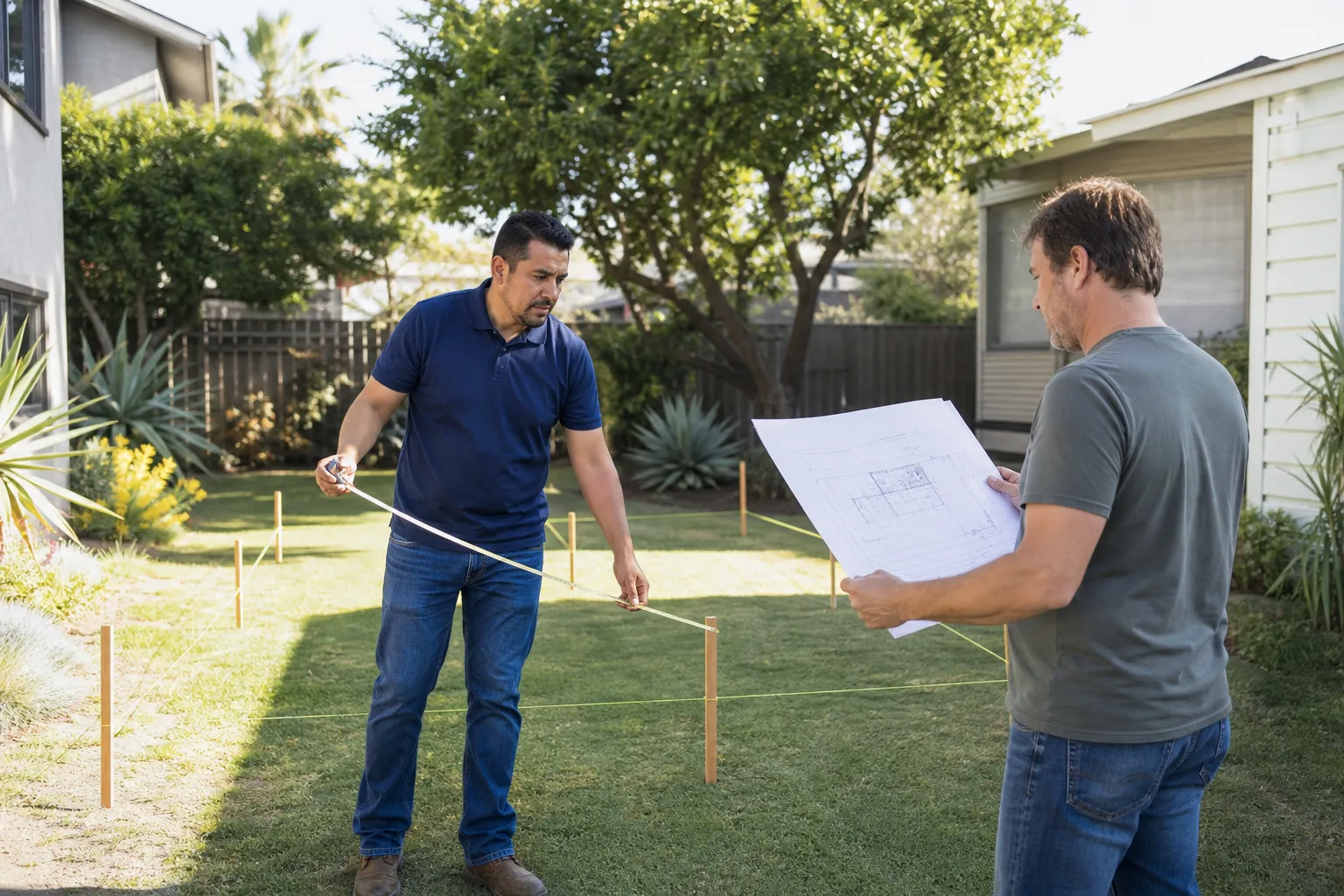
- On-site walk with a uniformed technician. We measure the buildable area, check slope and drainage, locate utility connection points (sewer lateral, water line, electrical panel capacity), and photograph everything. This is the step where a real person with trade experience – not a sales rep – reads the lot.
- Constraint mapping. We mark the realistic ADU footprint against setbacks. If the footprint pushes into the setback, we flag a likely setback variance – the city’s written permission to build closer to the property line than the standard rule allows – and note what the variance application typically runs.
- Build-method fit note. Based on access and site conditions, we note which construction approach fits cleanly – conventional stick-built with James Hardie siding, panelized, a Tuff Shed-style structure, or a factory-built unit from a platform like Abodu or Cover. You’re not locked into our recommendation; you’re informed.
- Written report. Within 3 – 5 business days you get a plain-language document: buildable footprint, top three constraints, utility notes, likely permit path, and site-prep cost ranges. The Garrison Standard applies here – if anything in the report is unclear, we explain it until it isn’t.
- Design handoff or stop here. You decide whether to move into full ADU Design & Permitting with us. If you take the report to another designer, it’s yours – it’s your property and your money.
Site Assessment Pricing in Thousand Oaks
Here are the real number ranges we quote in Thousand Oaks, based on the lots we’ve walked in the last several years:
| Assessment type | Typical range | What’s included |
|---|---|---|
| Flat-lot basic assessment (standard residential parcel, no slope concerns, no protected trees in/near build area) | $450 – $650 | Records pull, on-site walk, written report |
| Sloped or hillside lot assessment | $700 – $1,000 | Adds slope analysis, preliminary grading review, drainage notes |
| Full assessment with existing-structure evaluation (garage conversion or ADU-over-garage review) | $800 – $1,200 | Adds framing walk-through, foundation assessment, structural feasibility notes |
| Arborist add-on (if protected oak or other tree is present) | $350 – $600 | Certified arborist report, needed for most Thousand Oaks permits when protected trees are within 30 feet of work |
These are what we have quoted on actual Thousand Oaks jobs. Your lot may fall between ranges or slightly outside them depending on what we find. What we can promise is this: the written price you approve before we start is the number on the final invoice. No change orders, no “we discovered something” add-ons. Call (805) 309-3020 and we’ll give you an exact quote for your address.
If you’re not sure whether your project needs an assessment, ask us. We’ll tell you straight – including when the answer is “you don’t need one yet.” A live person answers every call, 24 hours a day, 7 days a week. No voicemail queue.
What The Garrison Standard Means on a Site Assessment
You’ll hear us reference The Garrison Code when we walk your lot. It’s not a slogan. It’s how the work operates, and it applies to the assessment just as much as to the finished ADU:
- Show up in the window. We schedule the walk for a specific window and we’re there. The technician arrives in uniform, background-checked, with your property file already pulled.
- Price in writing. The assessment quote is written before the walk happens. You approve it once. That’s the number.
- By the book. Every recommendation in the report references the actual Thousand Oaks municipal code section it’s based on. No “the city usually says” hand-waving.
- Leave it clean. An assessment doesn’t disturb much, but the walk itself leaves no trace. No flags left behind, no half-written notes taped to your door.
- Stand behind it for a year. If the report misses something that should have been caught – an easement, a protected tree, a setback conflict – we correct the report at no charge. That’s the 365-Day Done Right Promise, in writing.
Most Thousand Oaks homeowners we meet have already had one contractor miss a schedule or move a price at the door. The difference here is structural – it’s how Garrison Partners has operated since 2006, and it doesn’t flex when the job gets complicated.
How Thousand Oaks Codes Affect Your Assessment
Thousand Oaks is not a generic Southern California suburb when it comes to ADUs. Three local factors show up on nearly every assessment we run:
Hillside grading and slope
The city is built into the Conejo Valley foothills, and a meaningful share of lots have slopes over 10%. If your lot slopes toward the street, away from it, or across it, the ADU footprint changes. We’ve seen a Lynn Ranch lot where the “flat” area looked generous until the grading plan revealed a 4-foot retaining wall requirement that added $18,000 to site prep. The assessment catches that before it’s a surprise line item.
Protected oak trees
Thousand Oaks takes its native oaks seriously – the name isn’t decorative. The city’s oak tree ordinance requires a permit for removal of any protected oak and sets clear limits on what you can do inside the root protection zone. If your buildable area overlaps a root zone, you need an arborist report and possibly a modified footprint. We flag this on the walk, not after the designer has drawn the plans.
Fire hazard severity zones
Large portions of the city – particularly against the open space boundaries near Wildwood and the hills above the 101 – sit in Cal Fire severity zones. That brings requirements for defensible space, ember-resistant materials in certain cases, and sometimes water-flow verification for fire suppression. The assessment notes which zone your lot falls in and what it means for the build method.
Prefab, Panelized, or Stick-Built: What Your Lot Tells Us
One of the most useful outputs of a Thousand Oaks site assessment is a straight answer about build method. Not every platform fits every lot, and the cost difference between fighting a site and matching a method to it can run into the tens of thousands.
Here’s how it breaks down on the lots we see:
- Flat lot with a wide side yard and good street access: Most methods work. Conventional builds with James Hardie siding pencil out well, and factory-built units from Abodu or Cover can install fast with minimal site disruption.
- Narrow or gated access: Factory-built units may not physically clear the access path without crane work or panelization. A Tuff Shed-style structure or conventional framing may be the realistic play. We measure the actual clearances, not the optimistic ones.
- Steep lot with retaining requirements: The structure method matters less than the foundation engineering. Our report notes which method choices minimize grading rather than locking you into one.
- Existing garage conversion: Framing, foundation thickness, and ceiling height inside the existing structure answer the conversion-versus-replacement question. The assessment gives you those numbers.
Who Does Your Assessment
Reed Calloway owns Fielding ADU Thousand Oaks and handles or directly supervises every site walk. Reed has walked hundreds of Thousand Oaks lots across Newbury Park, Lynn Ranch, Wildwood, and the neighborhoods along Erbes Road and Avenida de Los Arboles. The technician who shows up is background-checked, uniformed, and knows the local code book without having to look up the basics.
You won’t get a rotating cast of subcontractors. You’ll get a named person who answers the phone when you call back with a question about the report.
FAQs – Site Assessment
How much does a site assessment cost in Thousand Oaks?
A site assessment in Thousand Oaks typically costs $450 – $1,200, with flat-lot basic assessments starting around $450 and full assessments with existing-structure review running up to $1,200 before any arborist add-on. Sloped lots, protected trees, and garage-conversion evaluations sit in the upper half of that range. Call (805) 309-3020 for an exact quote on your address – the price is written before we arrive and free to obtain.
Do I need a site assessment before designing an ADU?
You need one if your lot has slope, protected trees, septic, fire-zone requirements, or an existing structure you’re considering converting – all common in Thousand Oaks. If your lot is flat, clear, and straightforward, we’ll tell you to skip the full assessment and put the money toward design. When the answer isn’t obvious, the assessment costs less than the change orders it prevents.
How long does a site assessment take?
The on-site walk takes 90 minutes to 2 hours, and the written report lands in your inbox within 3 – 5 business days. The records pull happens before the walk, so the time on site is spent measuring and confirming, not waiting on documents.
What if the assessment finds something that kills the project?
Then you just saved the cost of a full design package and permit application. Thousand Oaks lots sometimes have constraints that make an ADU impractical at any budget, and it’s better to know that from a $700 report than from a $9,000 design set that gets denied. If the site is workable with modifications, the report maps exactly what those modifications cost.
Can you do the assessment and then hand the report to another builder?
Yes. The report is yours, and it’s written in plain language so any competent builder or designer can use it. We hope you’ll move forward with Fielding ADU Thousand Oaks, but the assessment stands on its own. No lock-in, no fine print.
Is it cheaper to combine the site assessment with design?
It can be – we often waive or reduce the assessment fee when you proceed into full ADU Design & Permitting with us. Ask about this when you call. The combined path usually saves $300 – $500 and means the person who walked your lot is the same person carrying the design through permit.
Call for Your Site Assessment
If you are serious about adding an ADU in Thousand Oaks – and you want the answer in writing before you spend real money on design – call (805) 309-3020. Reed will answer or call you back the same day, walk you through what the assessment covers on your specific lot, and get the walk scheduled. Free estimates. Written price. A live person answers, day or night.
Written by Reed Calloway, Owner at Fielding ADU Thousand Oaks, serving Thousand Oaks.